
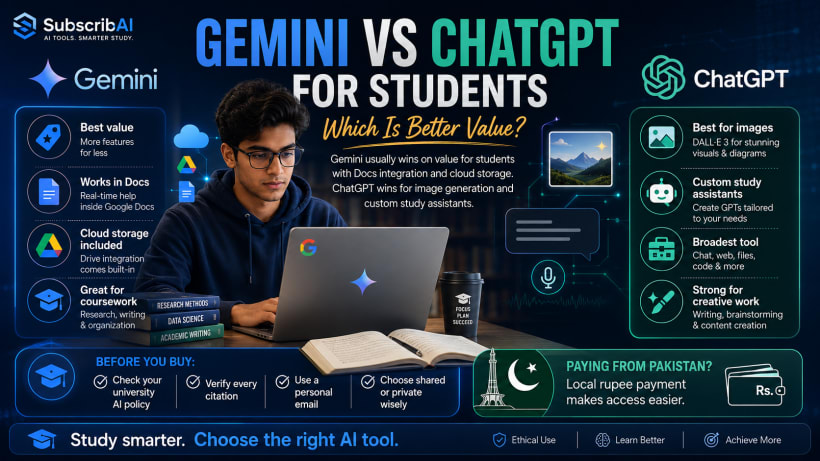
Which one should a student buy?
For most students choosing Gemini vs ChatGPT for students, Gemini is the better value — because the paid Google plan bundles cloud storage alongside the model, and because it works inside Docs and Gmail where coursework already lives. ChatGPT wins if you need image generation or you want the single broadest tool.
That is the summary. The rest of this guide explains the reasoning, the specific academic tasks each one handles better, how to use either without crossing into academic misconduct, and how to pay for a subscription from Pakistan.
Quick verdict by subject
- Essay subjects, humanities, law → either works; Gemini if you draft in Docs
- Maths, engineering, physics → try both on your own past problems before committing
- Computer science → ChatGPT for breadth, though Claude beats both for reading existing code
- Design or media coursework → ChatGPT, for image generation
- Anything with heavy reading → whichever handles your longest PDF best
The value argument for Gemini
The paid Google plan is not only a model subscription. Per Google's plan comparison, it bundles a large cloud storage allowance with the AI access.
For a student that matters twice over. If you were already paying for storage because your Drive filled up with lecture recordings and coursework, part of the subscription replaces a bill you already had. And if you were not paying, you now have somewhere to keep four years of work that will not vanish with a broken laptop.
The integration is the other half. Gemini works inside Google Docs, Sheets, Gmail, and Slides. When you are drafting an assignment in Docs, it can act on the document you are actually in rather than something you pasted into a separate tab. That sounds minor and is not — the copy-paste round trip is where most people give up on using these tools for real work.
Where ChatGPT is the better pick
Image generation. Included, and for design, media, architecture, or any coursework with a visual component, that single difference decides it.
Custom GPTs. You can configure an assistant once — "explain this the way my lecturer does, using our module's notation" — and reuse it all term. There is also a public store where someone has often built the thing you need.
Breadth and familiarity. More classmates use it, more tutorials exist, and if you get stuck, someone nearby has hit the same problem.
Voice conversation. Genuinely useful for revision — explaining a concept aloud and being questioned back is a better study method than rereading notes.
Head to head on academic tasks
| Task | Gemini | ChatGPT |
|---|---|---|
| Drafting in Google Docs | Best in class | Copy and paste |
| Summarising long PDFs | Very good | Very good |
| Maths working, shown steps | Good | Good |
| Code explanation | Good | Very good |
| Image generation | Yes | Yes |
| Custom study assistant | Gems | Custom GPTs and store |
| Cloud storage included | Yes, substantial | No |
| Voice study sessions | Yes | Yes, strong |
| Spreadsheet work | Best in class | Good |
Neither column wins outright. The pattern is that Gemini wins on integration and bundled value, while ChatGPT wins on ecosystem and creative output.
Using AI without committing academic misconduct
This section matters more than the feature comparison, and most guides skip it.
Almost every university now has a policy on AI use, and they differ sharply. Some permit it for brainstorming and prohibit it for drafting. Some require a declaration. Some ban it outright for assessed work. Read your own institution's policy before you use either tool on anything submitted. Not your friend's university, not a general article — yours.
Uses that are normally safe
- Explaining a concept you did not follow in the lecture
- Generating practice questions to test yourself
- Checking your own reasoning after you have attempted a problem
- Improving the clarity of sentences you wrote yourself
- Summarising a paper you have already read, to check your understanding
Uses that are normally misconduct
- Submitting generated text as your own writing
- Having it complete an assessment you were meant to complete
- Producing citations you have not verified exist
That last one deserves emphasis. AI tools invent plausible-looking references. A citation with a real author, a real journal, and a fabricated title or volume number is a common failure mode, and it is the single easiest way to be caught — a marker who checks one reference finds a source that does not exist. If you use AI anywhere near a bibliography, verify every entry against the actual journal or library catalogue.
The safe test: could you defend every sentence you submitted in a viva, without notes? If not, you have handed in something you do not own.
Paying from Pakistan
Both bill in US dollars, which is the practical obstacle. Recurring cross-border billing is a separate banking permission from ordinary international spending, and most Pakistani debit cards have neither enabled — which is why a card that once bought something abroad still fails on a monthly charge.
| Route | Works directly with Google or OpenAI? | Practical here? |
|---|---|---|
| Local card via a Pakistani gateway | No | Yes, paying a local seller |
| JazzCash or Easypaisa | No | Yes, paying a local seller |
| Bank transfer | No | Yes, paying a local seller |
| International credit card | Yes | Only if recurring billing is enabled |
| Virtual dollar card | Sometimes | Fees, and renewals fail on low balance |
For students the virtual-card route is particularly risky, because a renewal failing during exam week is exactly when you cannot afford to lose access. Buying locally in rupees avoids the top-up trap entirely. Current pricing is on the pricing page, and the payment problem generally is covered in paying for international subscriptions from Pakistan.
Shared or private for study?
For students this is usually an easy call, with one important exception.
Shared is generally fine for coursework. You are working on your own assignments with public course material, so the cost saving makes sense and the privacy tradeoff is small.
Private is worth it if any of these apply:
- Your dissertation or thesis contains original research you do not want visible
- You are working under an NDA on an industrial placement or funded project
- You use AI several hours a day and cannot risk shared usage limits during assessment periods
- Your work involves personal data from human subjects
That last one is not optional if your research involves participants — an ethics approval almost certainly does not permit putting participant data into a shared account.
The exam-period argument for private
Shared usage limits are shared. During assessment season everyone's usage spikes at once, which is precisely when a shared ceiling is most likely to bite. If a deadline depends on it, the private premium is cheap insurance. Fuller reasoning is in shared vs private.
What to check before buying from a reseller
- A real checkout, not a transfer to somebody's personal account
- Written replacement terms agreed before you pay
- A support channel you have tested with a question
- A clear answer on shared versus private
- No requests for your other passwords — no legitimate activation needs your university login
Our activation window and replacement terms are on the FAQ page.
How activation works here
- Pick the plan and tier on the product page and add it to your cart
- Pay in rupees at checkout through the local gateway
- Access details go to the email address on your order
- If anything is wrong, message support and it gets replaced
Use a personal email you will keep after graduation, not your university address — institutional accounts are usually closed when you leave, and that would take the subscription with it.
Mistakes students make
- Not reading the university's AI policy. The rules vary enormously and the penalties are serious.
- Trusting generated citations. Verify every reference. Fabricated sources are the most commonly caught misuse.
- Using the university email. You lose the account when you graduate.
- Buying during exam week. Set it up before you are desperate.
- Paying more for a weaker plan. Compare what you actually get, not the brand.
- Assuming it replaces reading. A summary of a paper you never read will not survive a seminar question.
- Relying on a shared account for a submission deadline. Shared limits are shared, and everyone peaks at once.
The short version
For most students Gemini is the better value, because the storage bundle and the Docs integration match how coursework already works. Choose ChatGPT if you need image generation, want custom study assistants, or prefer the tool your classmates use.
Whichever you pick, read your university's AI policy first, verify every citation it produces, and use a personal email address. Dollar billing is the only obstacle to buying either from Pakistan, and paying locally in rupees removes it.
Tell us your subject and how you study and we will say which one fits — get in touch.