Which one should you buy?
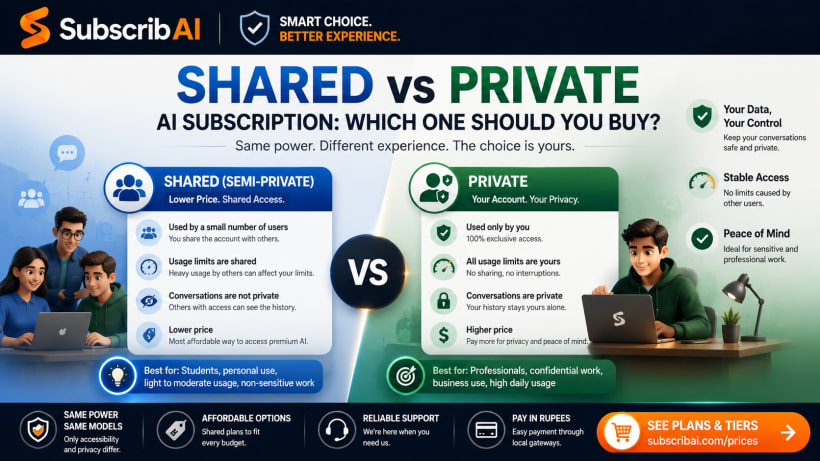
The difference between a shared vs private AI subscription is simple: a private account is used only by you, and a shared one is used by a small number of people at a lower price. The decision comes down to one question — would it matter if someone else could see what you type?
If the answer is yes, buy private. If the answer is genuinely no, shared will save you money and work fine. This guide explains what actually differs, so you are not guessing.
The two options in one table
| What differs | Private | Semi-private (shared) |
|---|---|---|
| Who signs in | Only you | A small number of users |
| Conversation history | Yours alone | Not private to you |
| Usage limits | All yours | Shared with others |
| Price | Higher | Lower |
| Suitable for confidential work | Yes | No |
What "shared" really means in practice
A shared subscription is one paid plan that several people use. Two consequences follow, and neither is hidden:
Usage limits are shared. Paid AI plans cap how much you can do in a window. On a shared account, somebody else's heavy afternoon can reduce what is left for you. Most of the time this is invisible; occasionally it is not.
Your conversations are not private. Anyone with access to the account can potentially see the history. That is fine for revising a lecture or drafting a caption. It is not fine for a client contract, medical information, or unreleased business plans.
The part people get wrong
Shared is not a lower-quality version of the model. You get the same model and the same features — Claude Pro is Claude Pro, ChatGPT Plus is ChatGPT Plus. What you are trading is exclusivity and headroom, not capability.
Choose private if
- You work with client material, contracts, or anything under an NDA
- You handle business documents, financials, or unreleased plans
- You use AI several hours a day and cannot afford to hit a shared ceiling
- You want your history to persist reliably and privately
Choose shared if
- You are a student working on your own coursework
- Your use is light to moderate — an hour here and there
- You want the cheapest route to a frontier model
- Nothing you type would embarrass you or breach a duty if someone else read it
If you are unsure, start shared and upgrade later. Moving up is easy. Retracting a client document someone else has seen is not.
A test that settles it
Before you buy, look at the last five things you asked an AI tool. Would you be comfortable if a stranger read all five?
- Comfortable → shared is fine
- Hesitant about even one → take private
That hesitation is the whole answer. It is cheaper to pay the difference than to explain a leak.
Security habits that matter either way
Whichever tier you take:
- Do not paste credentials, card numbers, or ID documents into any AI chat, private or not
- Use an email address you control — activation details go there, and a throwaway inbox loses you the subscription
- Change nothing about your other accounts. No legitimate activation needs your other passwords
- Keep confidential client work out of chat unless your client's agreement allows it
For reference on how the major providers treat your data, Anthropic publishes its approach in its privacy documentation, and the other vendors have equivalents worth reading once.
What it costs
Private costs more than shared on every plan we sell — the gap varies by product. Current rupee figures are on the pricing page, which is the only place worth checking, since exchange rates move.
If the private price is uncomfortable, shared on a more capable model often beats private on a weaker one. Ask us and we will tell you which trade is better for the work you actually do.
The short version
Shared and private give you the same model. The difference is who else is in the account and whose usage counts against yours. Confidential work needs private. Personal and study work is fine on shared. When in doubt, start shared and upgrade — one direction is easy, the other is not.
Browse what is available in the catalog, or read how activation works on the FAQ page.


